At MetLife Stadium in New Jersey, a Mexican journalist raised his hand.
Rodrigo Ornelas, from TV Azteca, wanted to ask Achraf Hakimi a question. In Spanish. Hakimi, born and raised in Madrid, is a fluent Spanish speaker. He understood the question perfectly. Anyone in the room could see that.
But a FIFA official cut Ornelas off. Spanish wasn’t permitted at that press conference.
What happened next was telling. Hakimi didn’t comply quietly. He pushed back, visibly trying to make the exchange happen anyway. The moment was caught on camera, shared widely, and within hours the FIFA Spanish language ban was dominating sports media across three continents.
FIFA reversed the rule on 15 June, announcing a Spanish interpreter would be provided. But by then, the story had already taken on a life of its own.
What Actually Caused the Ban?
Photo by Markus Winkler on Unsplash
This is more interesting than the headlines suggested.
FIFA didn’t draft a policy saying “no Spanish allowed.” There was no meeting where someone decided to exclude the world’s second most spoken language from a global football tournament.
What happened was more mundane, and in some ways more troubling. FIFA’s press conference system was built to provide interpretation only for the languages of the competing teams at each session.
In a match between Morocco and Brazil, that meant Arabic, Portuguese and French. Spanish, despite being spoken natively by more than 500 million people worldwide, wasn’t in scope.
The same gap surfaced at Vinicius Jr.’s press conferences. It affected sessions with Frenkie de Jong. These weren’t isolated incidents. They were symptoms of a system that hadn’t been designed to handle the full linguistic reality of a tournament being co-hosted by a Spanish-speaking country.
No one sat down and decided to exclude Spanish speakers. They just didn’t think to include them.
That distinction matters because it tells us where the failure lives.
It wasn’t a policy decision. It was a planning gap, the kind that happens when language logistics get treated as a secondary concern rather than a fundamental one.
The Blowback was Never Really about Logistics
When the video of Ornelas and Hakimi spread across social media, the reaction wasn’t a measured “FIFA made an operational error.” It hit deeper than that.
Spanish is the first language of seven World Cup-qualified nations in 2026. It is spoken by more than 500 million people natively and by close to 600 million in total. Mexico, one of the three co-hosts of this tournament, is a Spanish-speaking country. Matches are being played on Mexican soil.
And yet a Spanish-speaking journalist, at a World Cup press conference, was told he couldn’t ask his question.
The perception, regardless of intent, was one of cultural dismissal. Social media moved fast. “FIFA bans Spanish” was trending before most people had read past the headline. The story had already calcified into something larger than a logistical oversight. It became a symbol of whose voices get centred at global events, and whose don’t.
That’s a hard story to correct with a policy update, even a swift one.
FIFA’s reversal helped, and it should be acknowledged that they moved relatively quickly once the video spread.
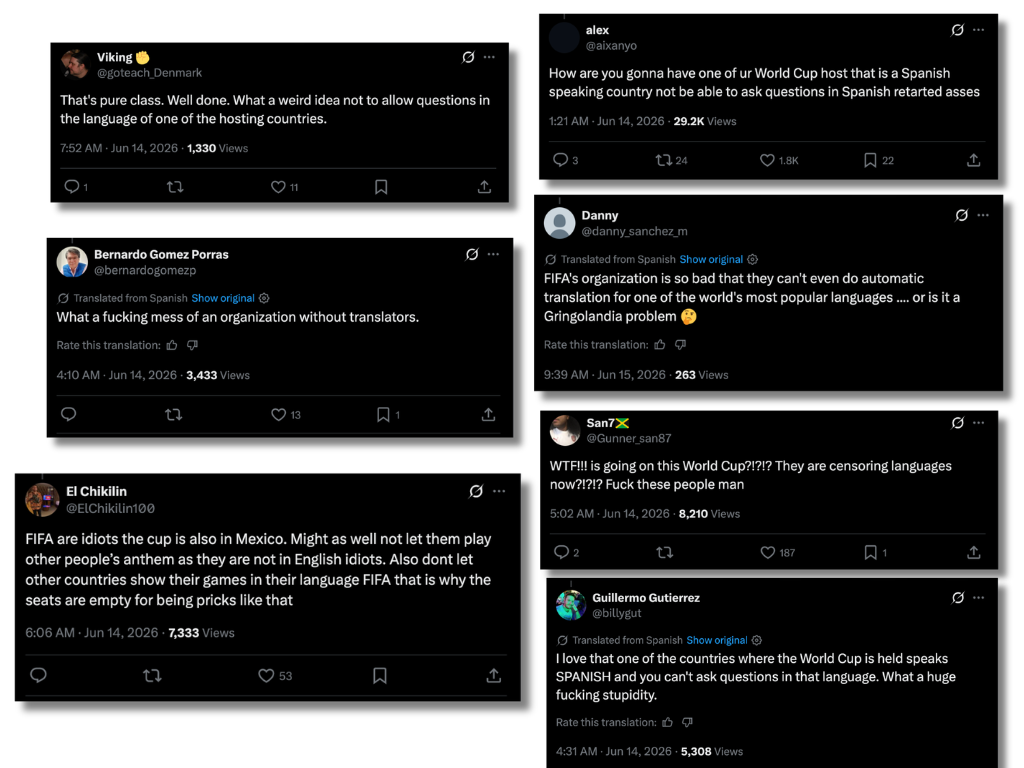
Some comments under the viral Hakimi and Orleans interview clip
But the response was reactive. The institution was found flat-footed, not because of malice, but because of something arguably worse from a brand perspective:
a failure to anticipate something entirely foreseeable.
Why Does This Keep Happening?
Photo by Johannes Hübner on Unsplash
This is the part that rarely gets discussed honestly: language logistics at major sporting events are genuinely difficult to get right.
Not impossible. Difficult.
The 2026 World Cup spans three countries, 16 host cities, and 48 national teams communicating in more than a dozen primary languages. On any given day, press conferences might cycle through Korean, Arabic, Dutch, Swahili, Portuguese, French and Spanish.
The traditional model of sourcing, credentialing, and deploying human interpreters at that scale requires months of advance planning, a reliable pool of accredited professionals and near-perfect operational coordination.
Most organising committees are stretched across thousands of competing priorities. Language services, invisible when they work and catastrophic when they don’t, tend to get planned late and provisioned inadequately.
This pattern isn’t new. The 2022 World Cup in Qatar had significant translation friction in the media zones. The Tokyo Olympics saw athletes, journalists and officials navigate real-time bottlenecks that slowed communication and frustrated broadcasters. UEFA has fielded press access complaints about interpreter availability for years.
The underlying issue is structural underinvestment in something that looks like a solved problem right up until the camera is rolling, and it isn’t. Tournament organisers assume the problem is smaller than it is. They plan for the languages they expect. They underprepare for the ones they don’t.
And then a journalist raises their hand.
The Real Cost is Trust
Photo by Victoria Prymak on Unsplash
There’s a version of this story that ends with “FIFA fixed it.” They reversed the policy, added an interpreter, and we moved on.
But the more instructive version asks: what did this moment reveal about how major institutions think about language access?
When Rodrigo Ornelas was stopped from asking his question, he wasn’t just inconvenienced. He was made to feel, in front of a watching media scrum, that his language didn’t belong in that room. That his audience, and by extension his culture, was an afterthought at an event his country is co-hosting.
That feeling doesn’t disappear when the interpreter arrives.
Multicultural audiences are paying attention at a level they weren’t a decade ago. Sponsors are watching the social media response in real time. Broadcasters in Spanish-speaking markets noticed.
A tournament positioning itself as a celebration of global football cannot afford to deliver the message, even accidentally, that 500 million Spanish speakers are an afterthought.
Language access is a form of respect. When it breaks down publicly, the reputational cost is disproportionate to the operational failure that caused it.
The gap between “we made a logistics mistake” and “we excluded your language” is enormous in perception, even when the intent was never exclusion.
There is a Better Answer Emerging
The good news is that the infrastructure problem FIFA ran into doesn’t require a small army of human interpreters to solve.
AI-powered real-time translation has matured considerably in recent years, and it’s increasingly being built for the exact environments where these failures occur: high-volume multilingual press conferences, broadcast sessions, live interviews, and international events where communication needs to flow across languages without delay or a last-minute scramble.
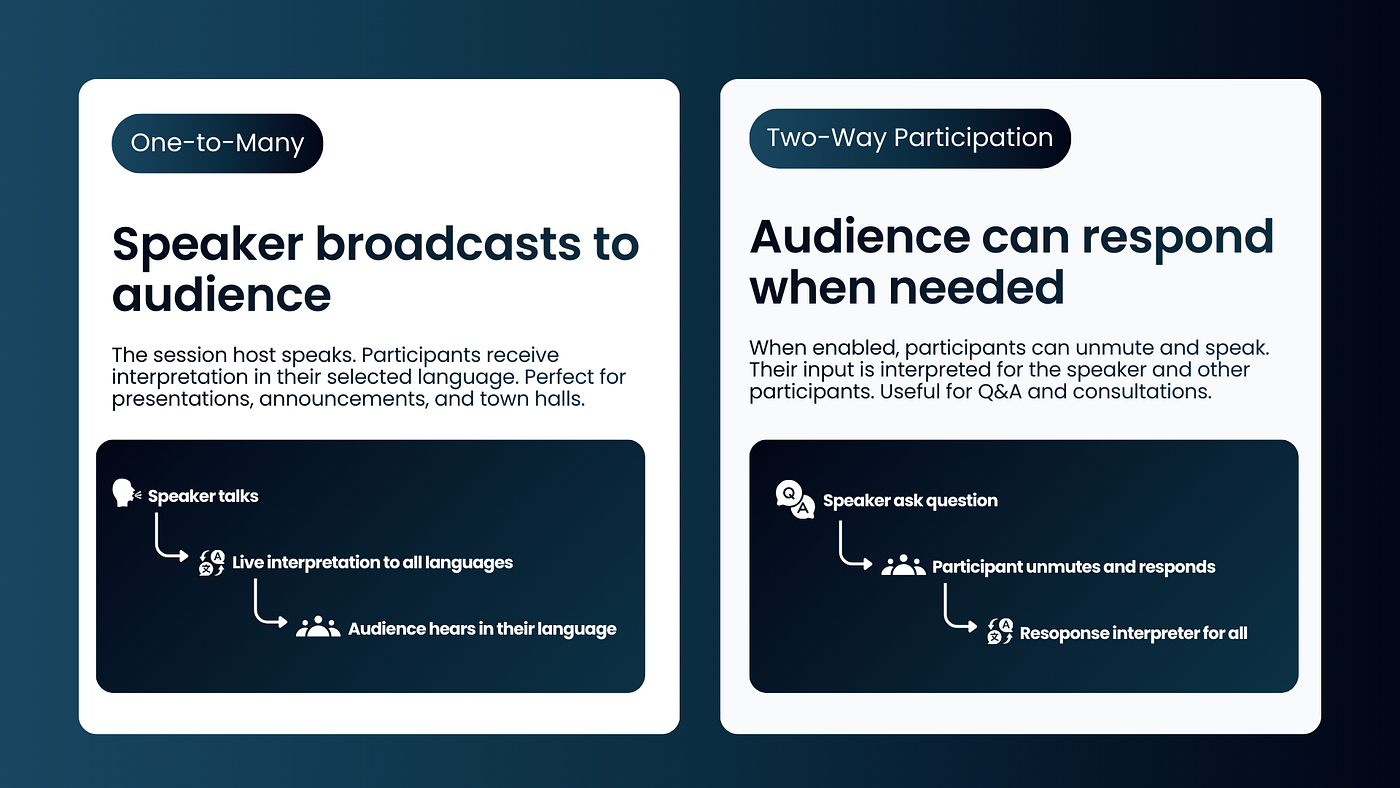
Tools like videotranslator.ai, built by Elephant Stripes, are designed for this kind of environment. The platform covers in-person interpretation, video calls, and broadcast scenarios. Its Broadcast mode specifically supports one-to-many multilingual interpretation: a single live session, multiple language outputs, delivered in real time.
How VideoTranslatorAI’s broadcast works
That’s the exact configuration FIFA’s press conferences needed and didn’t have.
It won’t replace the human element for every high-stakes interaction. Nuance, cultural context, and diplomatic sensitivity still matter enormously.
But AI translation offers something that a last-minute interpreter scramble simply can’t: scalability, consistency, and the ability to cover languages the event planners didn’t anticipate needing until the hand goes up and the camera is rolling.
For tournament organisers, the case is straightforward. The technology exists. The cost of not using it is demonstrably higher than the cost of deploying it.
The Bigger Lesson
Photo by Fauzan Saari on Unsplash
FIFA’s Spanish ban was, ultimately, a logistics failure that became a cultural flashpoint.
The lesson isn’t that FIFA is culturally dismissive, or that global sporting bodies are beyond reform. The lesson is simpler and more applicable across every large-scale international event: language access needs to be treated as critical infrastructure, not a secondary concern that gets sorted out when everything else is in place.
Build it in early. Plan for the languages you didn’t anticipate. Use available technology to cover the gaps that human resources alone can’t fill at scale.
The camera is always rolling somewhere. A journalist always has their hand up. The question is whether the system is ready to let them ask it in their language.
And right now, more often than it should be, the answer is no.